
Of all the challenges early-stage founders face in Canada, access to capital continues to top the list year after year. Long before a startup is ready for a pre-seed or higher venture round, it needs resources to build its first product, test out the market, win its first customer, hire its first employee, and prove its technology has value.
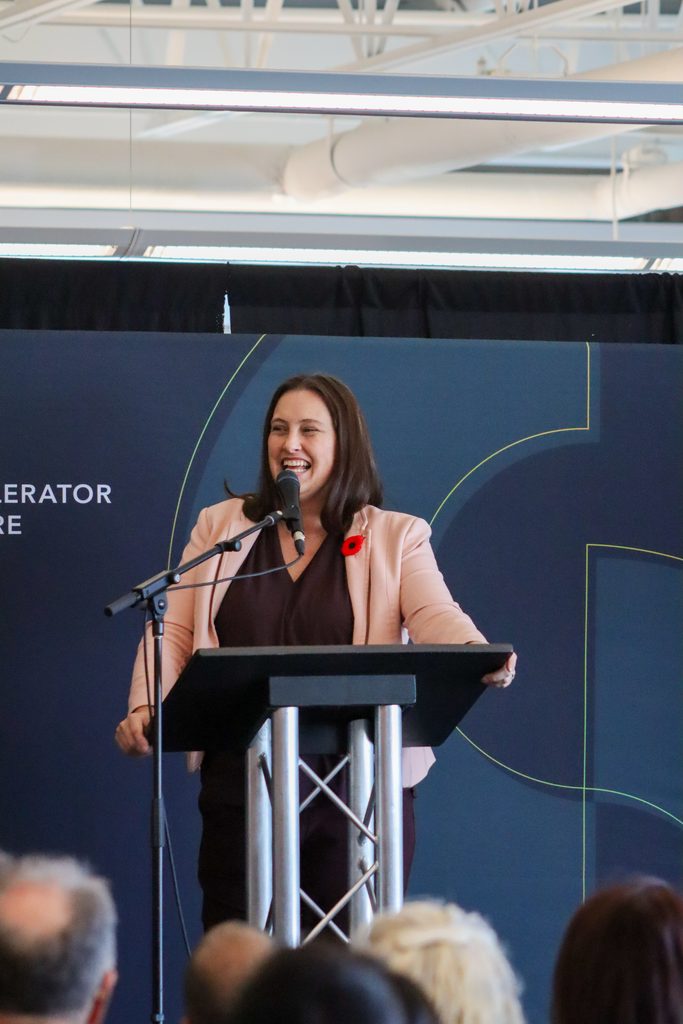
Addressing that challenge means putting money on the table, and that’s just what the Accelerator Centre announced at its annual AC Innovation Showcase on Tuesday, November 10. In her opening remarks, Accelerator Centre CEO Ruth Casselman announced the launch of AC:Backed, a new direct investment initiative to support early-stage Canadian startups.
“Through AC:Backed, we’re taking the next step in our commitment to founders. Not just connecting them to capital, but investing directly in the companies we’re helping to build. We’re doing this by reinvesting funds generated through our operations back into the Canadian innovation ecosystem,” Casselman said.
What is AC:Backed?
AC:Backed is not a venture capital fund. Instead, it is a direct investment initiative with decisions made by an external investment committee that supports the Accelerator Centre’s Board of Directors.
In an interview after the announcement, Casselman said a direct investment program gives the Accelerator Centre the flexibility to invest where they see the most need and opportunity, rather than supporting the goals of a venture capital firm’s limited partners. Using a third-party investment committee helps keep the decision uninfluenced by the Accelerator Centre’s team.
“Truthfully, we get very emotionally connected to a lot of these founders. We’ve been working with them for a long time. We know their stories, we love their stories. But this is an investment. It’s a financial decision, and we needed investment experts to bring a more neutral, third-party view on whether it’s a good investment. The intention is that it brings returns back to the Accelerator Centre that we can then reinvest in other companies,” she said
.From the AC:Studio program to the Aerospace Accelerator, the mission of the AC is to help startups become investment ready. Casselman said the reality is that the ecosystem is nowhere near the amount of capital needed to grow all the high-potential companies in the region.
“They have innovation, they have a big market, but they need to be able to actually scale their businesses. Sometimes it’s presented as, ‘Canadian companies can get so much done for less money,’ which is great for those companies. But why are they always in the position of having to do more with less? What if they had more to do more with? That’s what we’re hoping to start.” Casselman said.
Giving an edge to a deeptech startup
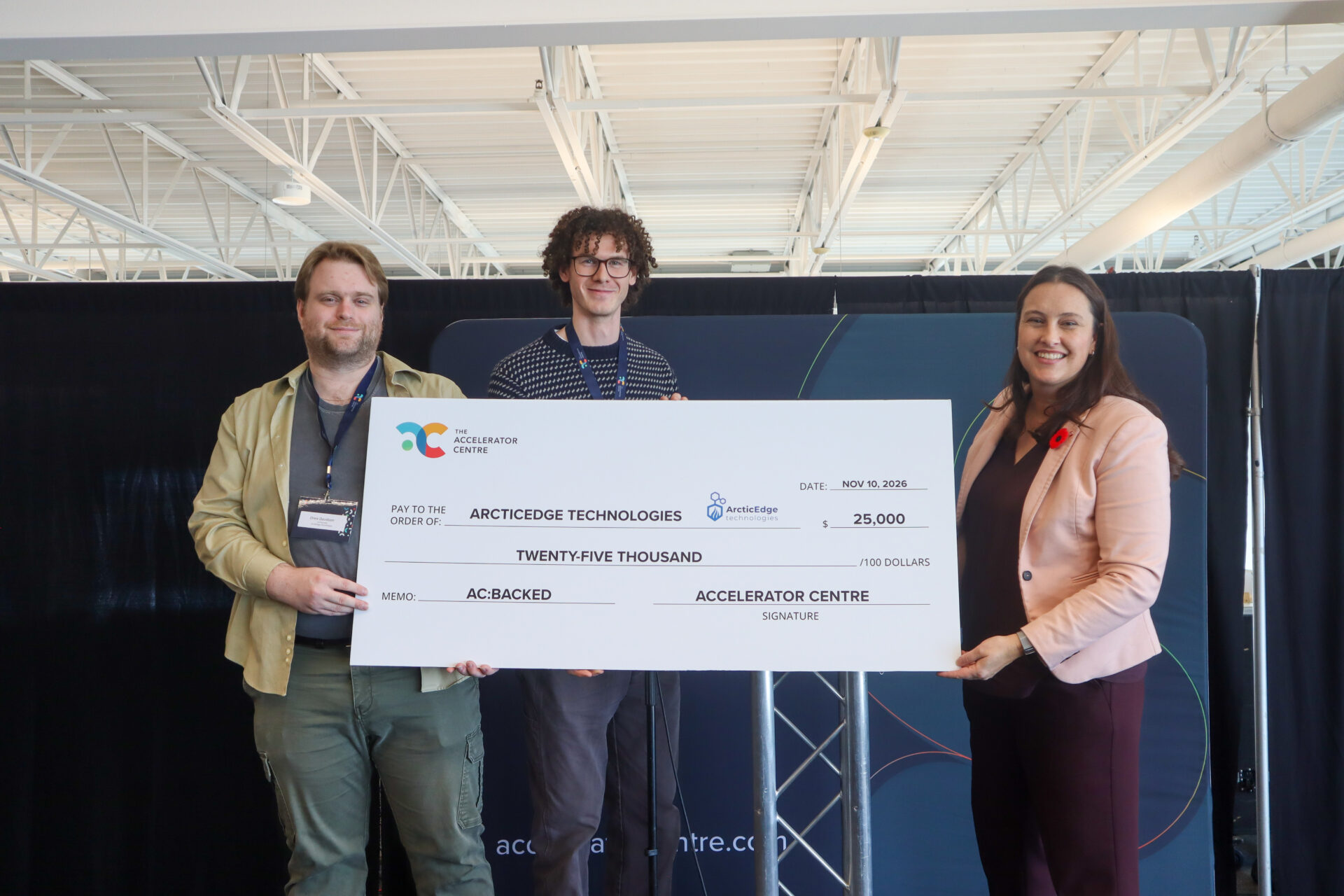
Along with the launch of AC:Backed, Casselman also announced the first startup to receive an investment through the initiative. Waterloo-based ArcticEdge Technologies is receiving $50,000 from AC:Backed with $25,000 in cash and $25,000 in in-kind support through participation in Accelerator Centre programming.
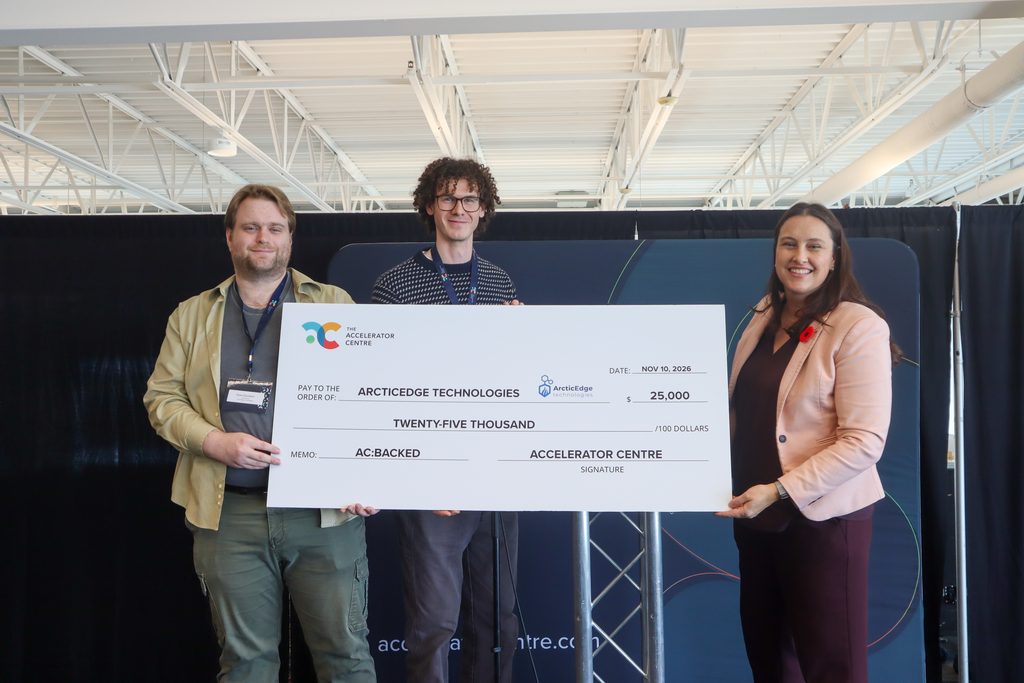
A graduate of the AC:Studio program, ArcticEdge is developing a new material to replace the PFAS-based moisture barriers used in everything from personal protective equipment (PPE) to sports and active gear. Commonly known as “forever chemicals,” PFASs pose serious risks to human health and have been restricted across over 180 countries, including some proposed bans.
“They’re a great example of the innovation we want to see succeed: ambitious Canadian technology tackling a meaningful global problem. This is a milestone for ArcticEdge and an important moment for the Accelerator Centre,” Casselman said.
Kade Truman, ArcticEdge’s co-founder and CEO, said the investment from AC:Backed and the continued support from the Accelerator Centre will help keep the team moving forward as it meets with potential partners to bring its product to market. He added that deeptech companies take longer to start earning early revenue, which makes traction a challenge.
“Having the Accelerator Centre watch us for so long, see what we’re doing, and validate it is very meaningful, and it’s a good signal to others in the market. It’s money, so we can keep working, but it’s also validation that what we’re doing is the right thing. It’s also confidence that we’re ready to approach other investors and present ourselves in a way that signals we’re a worthwhile investment with the fundamentals they need to put money up,” Truman said.
ArcticEdge’s mission is a personal one for CTO and co-founder Drew Davidson. His mother is a retired firefighter who witnessed the impacts of PFAS-based protective equipment on her colleagues.
After returning from a funeral of a fellow firefighter who died due to cancer, Davidson’s mother Kelly asked him if he thought he could do anything to help. Davidson’s background is in nanotechnology engineering and chemical engineering, and so like any scientist, he went to the lab.
Davidson’s mother was in the audience today to hear the news and see David, Kade, and the ArcticEdge team being celebrated.
“I don’t think she ever expected it to come this far. She’s really happy there’s a solution in the pipeline that can help her colleagues who are still working in the fire department. She mentioned that after it came to light that PFAS in the gear was a health issue, it was on her mind every time she put that gear on,” Davidson said.
Celebrating a new class of Accelerator Centre graduates
After the AC:Backed announcement (and presentation of the over-sized cheque), Casselman invited Truman and the founders of four other startups graduating from cohort 2 of the AC:Studio program.
AC:Studio is supported by the Government of Canada through FedDev Ontario and provides companies with up to $100,000 in funding and support, combining capital with hands-on mentorship and practical resources to help founders bring their innovations to market.
In addition to ArcticEdge, the presenting companies were:
Jitto
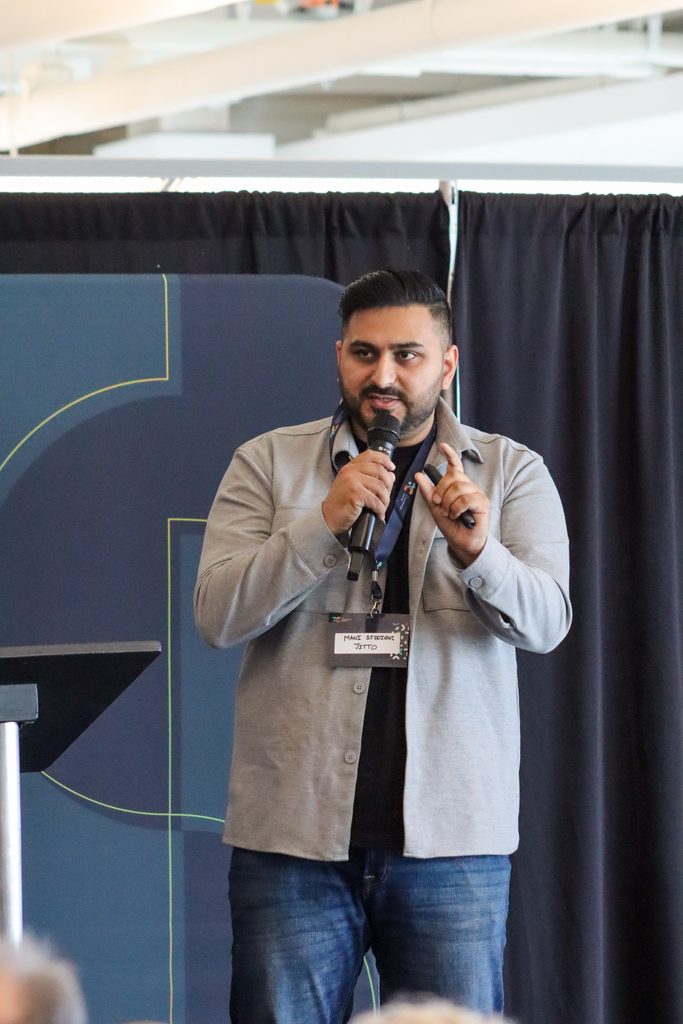
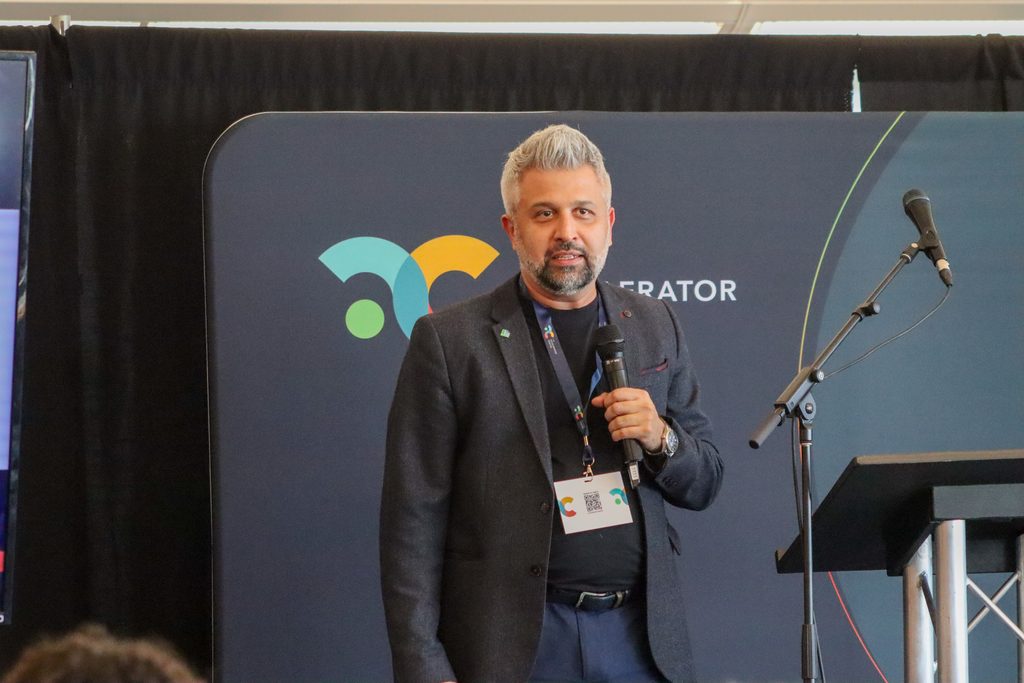
Founder Mani Siddiqui shared how the company is digitizing the produce industry. Inspired by his mother being shocked by a pint of blueberries costing $28, Siddiqui set out to understand how produce made its way to communities in Northern Ontario. It turns out it’s a disjointed supply chain with data issues and service quality driving up prices. Jitto takes supplier data and provides transparent pricing to restaurants and markets.
“It started with a blueberry. We’ve moved roughly $18–20 million worth of produce, just moved into our first warehouse, and closed a $500,000 funding round a couple of weeks ago. We’re ready to scale,” Siddiqui told the crowd.
LandLogic
It was a homecoming for CEO Arash Shahi, a civil engineering graduate of the University of Waterloo. On stage, Shahi shared how today, LandLogic is building a real estate and land intelligence platform. The company has digitized and normalized property data from across 100 municipalities and during its time at the AC, secured a partnership with Teranet, which runs Ontario’s land registry. That partnership gives LandLogic direct access to virtually every realtor and land developer in the province on one platform.
PatientCompanion
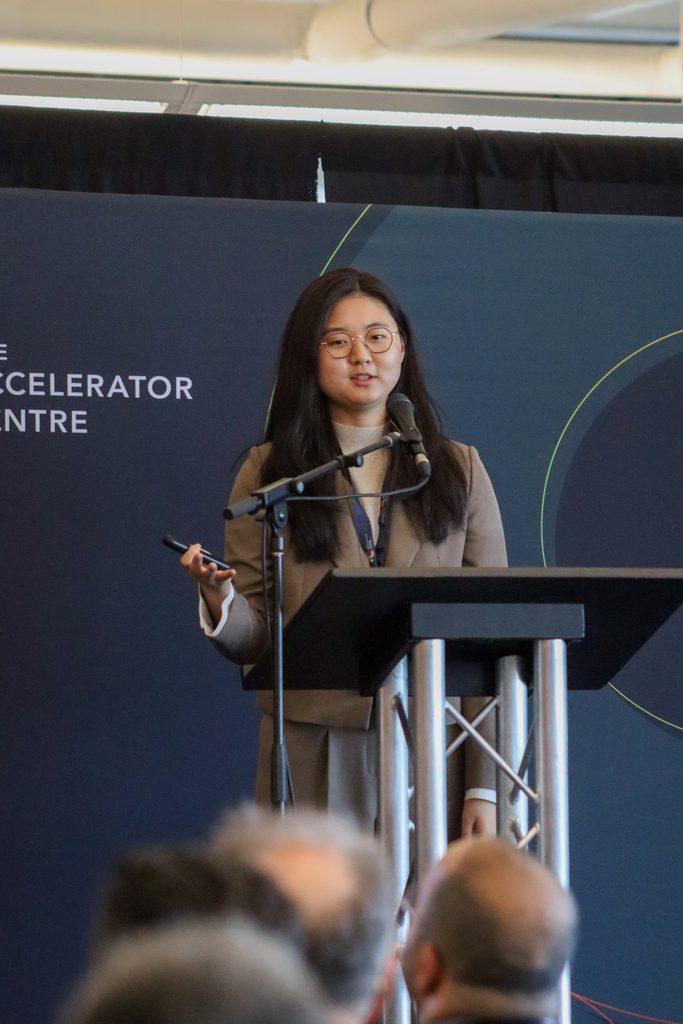
Christy Lee first saw the problem of nurses managing patient requests while volunteering in hospitals and long-term care facilities. Patients would press a red button when they needed assistance, from more medication to a new pillow.
“The nurse has to go in, ask what the patient needs, leave, bring back water or a blanket or find another staff member, and return. That takes about 10 to 15 minutes, wasting nurses’ time and delaying patient care,” Lee said.
PatientCompanion solves this by letting patients say exactly what they need — help to the washroom, pain medication, water or a blanket — by tapping a button, texting, or speaking in their own language, with real-time translation and transcription.
Steadiwear
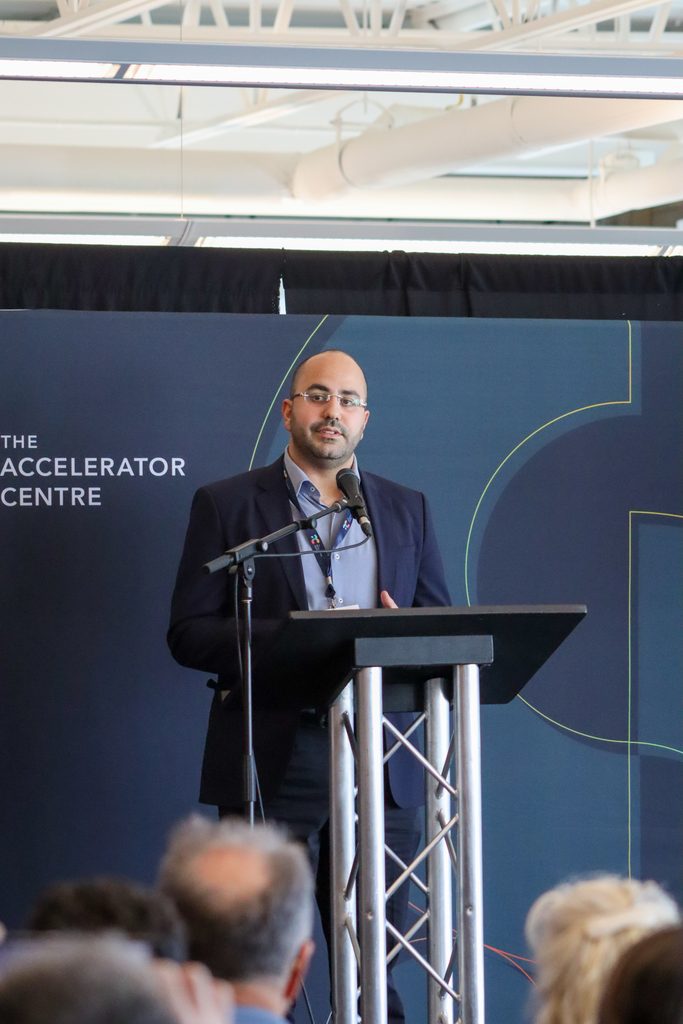
Emile Maamary was also inspired by a family member to solve a problem. His grandmother suffers from essential tremor, a benign neurological condition that seriously reduces quality of life. Over a million people in Canada live with essential tremor or Parkinson’s disease, and have daily struggles with simple tasks from writing to drinking.
Steadiwear has developed a battery-free mechanical glove designed to reduce hand tremors. The technology is based on the same process that makes buildings earthquake-resistant design.
“We have about 8,000 customers to date, about 5,000 of them gained during our time in AC Studio, thanks to a major deal in the United States through Veterans Affairs, where our device is fully covered. During our time at the AC, we reached break-even, grew our book by 250% and closed our seed round. We’re grateful for all the support from the program,” Maamary said.
After the presentations, Casselman invited the showcase audience to explore the five companies presenting along with another 35 innovative startups across the Cora Group space at 300 Hagey Blvd.
“These companies are a great reminder of why Waterloo Region remains such an important place for innovation. We have extraordinary talent, people willing to take risks, challenge how things have been done and solve problems that matter, and an ecosystem that knows how to come together to support founders,” Casselman said.

