
Leaders across virtually every size organization are pushing their teams to use artificial intelligence (AI) tools in their daily work. According to recent data from Forbes, 72% of surveyed businesses had adopted AI for at least one business function.
But simply adopting AI doesn’t equal success.
Even as AI models improve seemingly every day, putting them to work successfully is proving more difficult. Research from MIT showed that 95% of AI projects had failed to deliver on their objectives. The reasons for project failure vary, from lack of clear problem definition and data quality issues to not having the right subject matter experts involved.
But of all the issues impacting AI adoption success,it’s the complexity of AI interfaces and the different abilities of large language models (LLMs) that are preventing teams from realizing the true potential of AI transformation.
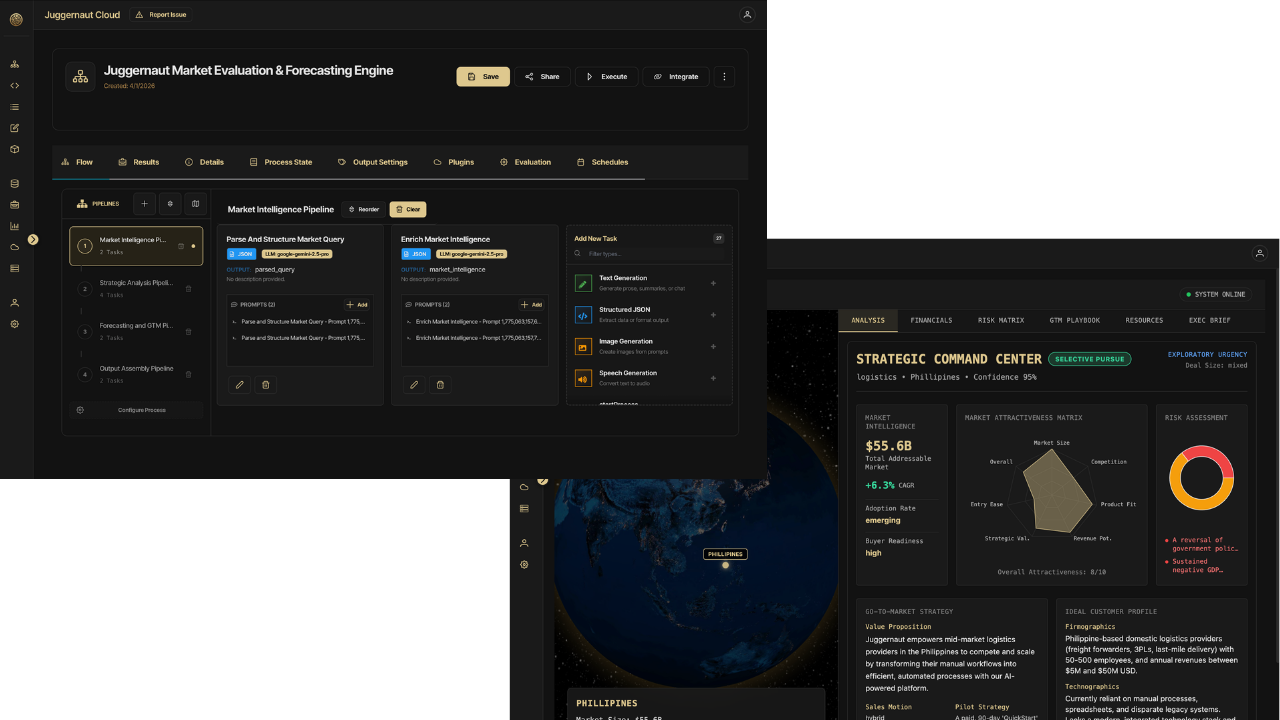
Solving these challenges is the mission of Ken Naku and JB, the co-founders of Juggernaut Labs. The startup is developing an AI automation workflow platform that lets people like accountants, marketers, and salespeople build and manage AI-powered business processes without needing to code.
Going beyond vibe coding
Vibe coding and agentic engineering platforms like Loveable, Base 44, and Claude Code have done more than change the way people code. These tools have made it possible for almost anyone to build an app or design a website.
But while these tools make building a new app easy, they are often locked into one vendor’s LLM and lack the security, guardrails, and governance required for managing sensitive information and security in a business context.
Juggernaut Labs is changing that with its platform that supports nearly 100 different AI models — including, Claude, Gemini, Deepseek, and ChatGPT — so businesses can mix and match models based on cost and capability.
Naku spent over a decade working as a software engineer and consultant where he saw first-hand the challenges of implementing new systems, especially AI.
“Many of the businesses I worked with were struggling to implement AI right. The challenge for many was that the people who were the domain experts couldn’t really contribute to the system. It was a game of telephone. You tell the developers what your intentions are and then they have to interpret it into the system,” Naku said.
With Juggernaut, it’s the domain experts themselves who get to put their requirements into action. Whether it’s building a lead generation system or a financial analysis tool, Juggernaut unlocks the power of AI for almost every employee in a managed, secure way.
“With Juggernaut, it’s easy for someone who is an accountant or marketing expert, not necessarily a coder, to go in and contribute to these systems,” Naku added.
Adding service and value to AI adoption projects
While the platform makes AI automation simple for organizations, JB was quick to note that their team is there to help when needed.
“People are being told that they need to adapt and adopt AI, but nobody really knows how to start. Then we see a lot of things that break in production that worked as a proof of concept,” JB said.
The solution is a fractional AI success manager role that Juggernaut Labs offers to its clients.
“We can go in, understand the processes involved, and then make suggestions to where organizations and teams can actually make improvements. Then they can either build it themselves or our team can help,” JB said.
Another challenge for AI adoption projects is choosing which model to use. Naku said that many teams will use a frontier model — the latest version from an AI company — without validating if less expensive models can perform a part or all of a workflow.
“There’s a lot of people who are spending thousands of dollars on Claude because it’s a frontier model. People are using the latest models to draft an email that would only cost you pennies on a lower-tier mode,” Naku said.
Getting help from the Accelerator Centre
For JB and Naku, joining the Accelerator Centre’s AC:Incubate program was an opportunity to plug into the local tech community and get an outside perspective on what they were building. AC:Incubate provides early-stage, tech-based startups with a structured program to take their ideas from paper to prototype to production.
“We wanted to get involved in the local tech scene and get guidance. Early on, that guidance helped the team get clarity on who our target customer actually was,” JB said.
For Naku, the value showed up in more specific ways. Working largely on his own on the technical side, the mentor relationships gave him a sounding board he didn’t otherwise have.
“I struggled to figure out certain key elements of the user interface that were holding it back. Through some of the mentor meetings, you have those moments where you just need to bounce ideas off people,” Naku said.
What’s next
Looking ahead, the team sees the platform evolving beyond workflow automation into what Naku described as process-driven applications — purpose-built tools with custom interfaces layered on top of automated workflows.
“Think of a financial trading tool that analyzes a stock over 20 steps, gives you a prediction and a strategy, and then presents it through an interactive dashboard where one click lets you execute the trade,” Naku said.
“The next evolution is keeping the human in the loop. Talking to a chatbot is cool, but that’s not the best way to make a decision that can make or break you.”

