
If you’re not a morning person, then there’s probably a morning person in your life who you’d wish was a little less chipper. But what if we told you that being a morning person was more than just an attitude or coffee-fueled personality? That’s right, there’s science behind why some people function better without a triple shot latte.
For many people who struggle to function within the traditional workday, the problem is more than just a matter of “not being a morning person”. It’s due to a biological misalignment that is often dictated by genetics, chronotypes (their innate circadian rhythm), and the timing of morning sunlight exposure.
It’s a problem that does more than make us cranky. It can lead to significant impacts on mood, mental health, and even cause seasonal affective disorder.
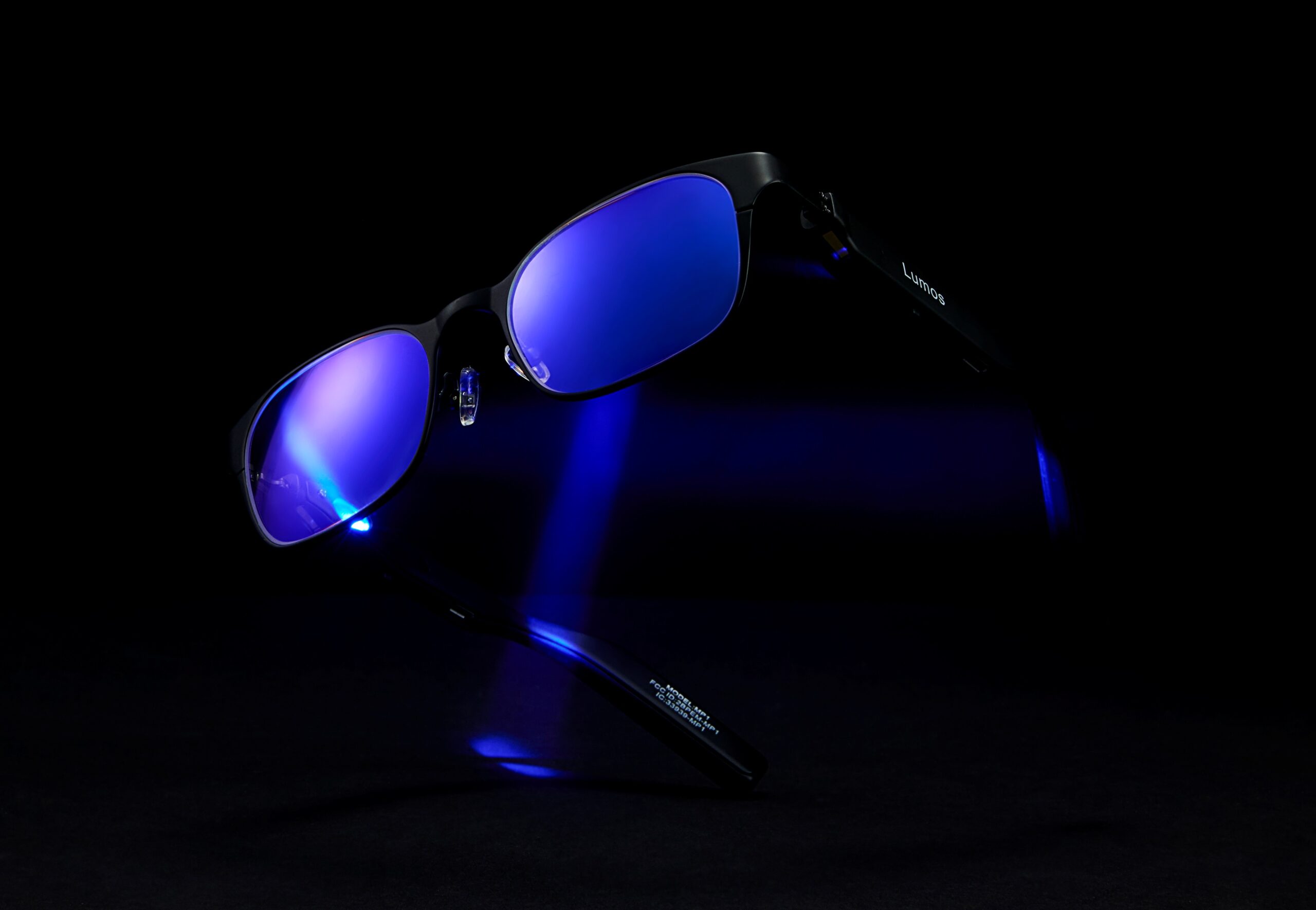
To solve this, Lucas Wen Tang and Felix Xu of Lumos have developed Lumos Glasses, patented light therapy glasses designed to set the circadian rhythm through subtle, fashionable eyewear that fits into a busy daily routine.
Waking up on the wrong side of the bed
The idea for Lumos started with Lucas’s personal battle with his own sleep schedule while studying engineering at the University of Waterloo.
“I couldn’t wake up in the morning, so I would skip all my morning classes and just show up to my afternoon classes. I was still first in my class, but then when I started working, that’s when the problem really started,” Lucas says.
Skipping a morning class is one thing. Skipping a mandatory morning meeting at work is another. Getting up at 6 am made him feel like an empty shell at work, so he decided to look into sleep science for a solution.
“I ended up writing about chronotypes for an English class and how they determine if you are a morning person or a night owl,” Lucas says. “I tried melatonin pills and light therapy lamps, but none of them really worked for my particular schedule.”
Necessity is the mother of invention
For a night owl like Lucas, it is critical to have exposure to sunlight first thing in the morning to set his circadian rhythm. Lucas’s problem wasn’t that existing solutions didn’t work, it was that they didn’t work on the go. That mismatch in utility inspired him to invent Lumos light therapy glasses.
“I was inside all the time. I was an engineering student in basement lecture halls, but I needed sunlight first thing in the morning. The solutions at the time didn’t cut it because I couldn’t sit in front of a light therapy lamp—I had to get to work,” Lucas says.
Lumos glasses provide light therapy on the go in a fashionable package.
“I wanted something that I could wear on the bus to class or work. The first prototype was a little wonky, and that’s when I cold called Stanford Sleep Science’s Dr. Jamie Zeitzer for advice,” Lucas recalls.
Zeitzer is a world-renowned expert in circadian rhythms and sleep science and a professor of psychiatry and behavioural sciences at Stanford University. He joined the team as a co-founder after seeing Lucas’s early prototype.
With the validation from a leading researcher, Lucas’s next step was to refine the form factor. At the same time, he had an opportunity to work at Apple as a product design engineer where they drilled into him the idea that form factor and fashion are absolutely critical for the adoption of any consumer products.
“I just didn’t want to make something that you could just wear on your head. I wanted it to be subtle. When you wear Lumos Glasses, it’s very hard to see that there’s light coming in from the side. The technology uses proprietary coatings to ensure that while the wearer receives light emulating a blue sky, the effect is nearly invisible to those around them,” Lucas says.
Fine-tuning the vision with help from the Accelerator Centre
Lucas and Felix joined the Accelerator Centre’s Global Impact Creator program to bridge the gap between engineering and the marketplace. Lucas is a graduate of the University of Waterloo, and knew the Accelerator Centre’s reputation for programming and mentors like Rob Farnham, Steve Fyke, and Ellyn Winters-Robinson.
Felix and Lucas used help from the Accelerator Centre to navigate the complexities of turning Lumos into an international brand. Accelerator Centre mentors provided guidance on everything from social media marketing on Instagram to deciding what e-commerce platforms to choose.
“We’re engineers, so we really wanted to learn about how to go to market and how to advertise our product,” Felix says.
What’s next for Lumos?
As 2026 gets underway, Lumos has launched its glasses and Lucas and Felix are focused on scaling through offline partnerships with glass stores, wellness clinics, and sleep clinics. The company has already secured FSA and HSA approval in the United States, making the glasses more accessible to a broader audience.
“When people see and put on these glasses, they sell like hot cakes. It’s amazing. And so, we want to offer more ability for people to go in and test them in person,” Lucas says.
The future of Lumos involves moving beyond a “one size fits all” approach toward a personalized health platform.
“We want to kind of close the loop with intervention with our glasses with a platform that can measure your internal circadian rhythm through predictive algorithms so that we understand you better and improve more lives,” Lucas says.
Today, Lumos is going beyond helping night owls wake up earlier. Light therapy is a clinically validated tool for improving mood and sleep, and Lumos completed its own randomized double blind clinical trial at the University of Waterloo demonstrating improvements in sleep quality, depression scores, and cognitive performance. The company is now positioning Lumos not just as a morning hack, but as a science driven wellness platform.

