
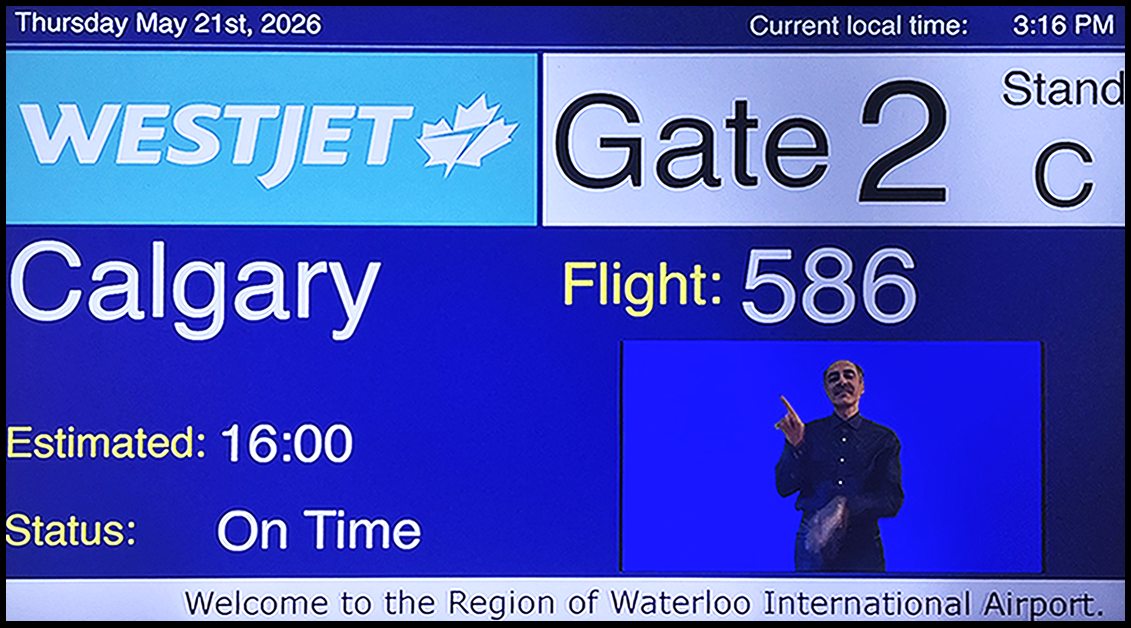
The airport can be a stressful place even for the most seasoned traveller. You get through check-in and security and then have to navigate crowds to find your gate. Once there, you finally have a chance to relax before boarding begins. Then you hear an announcement over the intercom—your gate has changed, and you quickly grab your carry-on and race across the terminal.
Now imagine that scene as deaf person. The gate change announcement gets made, you see people moving around and leaving, but you have no idea why. It’s a scenario that plays out daily for deaf people travelling by air, and it’s something Mehdi Masoumi wants to see changed.
Masoumi is the founder of Deaf AI, a startup that develops technology to provide deaf people with the same experiences as hearing people in public life and the digital world.
“When deaf people are at the airport, they don’t have equal access to information. We’ve built a solution that translates boarding announcements into the language they use, which is sign language,” Masoumi said.
Sign language is not universal
Most of us think of American Sign Language (ASL) as the standard way deaf and head of hearing people communicate. Just as spoken language varies across Canada, so does sign language.
“Even within American Sign Language, there are many localized signs. If you go from the Deaf community in Toronto to the Deaf community in Los Angeles, you’ll find some different signs. That doesn’t mean people can’t understand each other, but it does affect fluency and translation,” Masoumi said.
In Canada alone, there are at least two official sign languages and even more within individual communities. In the 2021 census, 11,000 Canadians said ASL or Langue des signes québécoise (LSQ) as their mother tongue. Masoumi said that for many Deaf people, even the text on a screen can be difficult to understand since it is not in their language. He added that ASL or LSQ is their first language and written English, or French is a second.
“Many can struggle to read the announcements even if the airport offers closed captioning,” he said.
Designing with the Deaf community
Masoumi moved to Canada from Iran to study mechanical engineering at the University of British Columbia. He moved to Waterloo, Ontario, after graduating to build on his ideas for creating a business that used artificial intelligence and machine learning to support the Deaf community.
He first learned about challenges the Deaf community faces from family members who worked with deaf students in his native Iran. During the pandemic, Masoumi saw sign language interpreters on the news and those earlier conversations came back to him.
“I decided to explore how we could use AI and other technologies to make information more accessible for deaf people, not just in emergency situations like COVID,” he said.
With his connections in the Deaf community, Masoumi knew that developing solutions for them meant understanding their culture and needs.
“The strategy was that we develop every single idea with the community to make sure everything aligned with Deaf culture and expectations, and that we weren’t damaging their language or culture,” Masoumi said.
Deaf AI has advisors, mentors, and leaders from different Deaf communities who help them manage conversations and shape the product. They also work with Children of Deaf Adults (CODAs) who act as a bridge between the two cultures.
Translating announcements into the different sign languages has additional layers of complexity compared to written language translation.
“The nature of sign language is that it’s very expressive. It’s not just about the position of the hands and fingers. Eyebrow movement, facial expression—these are all very important across sign languages,” he said.
How the Aerospace Accelerator Program helped
Masoumi’s vision for Deaf AI is to be the solution for sign language translation. In May 2026, the company started its first pilot project at the Region of Waterloo International Airport (YKF) to see how it performs in real-world environments.
“The airport is the best scalable starting point, because if we can offer something reasonable there, it can expand. Eventually, we want to offer this to transit agencies, airports, train stations—anywhere travel announcements happen,” he said.
The opportunity to work with the airport’s team was just one advantage of being a part of the Aerospace Accelerator Program. The six-month program connects startups with mentorship, investors, and partners like the Region of Waterloo International Airport.
“That’s where the Aerospace program has been invaluable. It’s not easy to bring an airport on board and ask them to test a new solution. We’re lucky to have the AC and a partner airport like YKF that genuinely embraces innovation and is based in Canada’s innovation hub,” Masoumi said.
Tanya Herback, operations manager at the Region of Waterloo International Airport said as airports continue to evolve, accessibility must remain at the forefront of how we design the passenger experience.
“Every airport in Canada is working toward stronger accessibility standards, and we’re always looking for innovative solutions that help make travel more inclusive. Deaf AI’s technology has the potential to transform how important airport information is communicated to deaf and hard-of-hearing travellers, helping ensure that all passengers can navigate their journey with greater confidence, independence, and ease,” Herback said.
Talking to a partner like an airport is no small undertaking. Masoumi said the AC mentors have helped him revamp Deaf AI’s value proposition and shape how he speaks with potential partners.
“The key gap we had was in communicating with airport officials. This isn’t usually their lived experience unless they have a deaf family member. It takes time for them to process the need, allocate budget, assign a team, review the proposal, and validate it with accessibility advisors. The mentorship helped me understand how to support them through that process and make the right resources available,” he said.
As Masoumi gets ready to launch the pilot, he said he is excited to see how the Deaf community responds.
“Accessibility shouldn’t be considered a luxury. It’s a need. And innovation can make it more achievable,” he said.

