
But while reality has made progress towards the possibilities, the reality is that in mission-critical environments like hospitals or busy airports, a robot that gets “lost” or behaves unpredictably isn’t just an inconvenience—it’s a safety risk. Vivek Burhanpurkar, CEO of Cyberworks Robotics, is leveraging decades of foundational robotics expertise to replace the conventional AI logic of existing autonomous robot architecture with a new artificial intelligence (AI) approach that makes sure robots do exactly what they are supposed to do, every single time.
The Godfather of Autonomous Navigation
Burhanpurkar’s history with robotics goes back to his time studying at the University of Toronto in the 1980s where he authored the world’s first academic thesis on autonomous mobile robots designed specifically for indoor, dynamic environments. His pioneering work caught the world’s attention early. In 1984, he was profiled in The New York Times for developing the first autonomous industrial mobile robot, and by 1987, he had launched the world’s first autonomous robotics company.
“Robots were so new that everybody in all of the media and the world covered it,” Burhanpurkar recalls.
That early leadership position has evolved into a career spent solving the same fundamental problems that have persisted for forty years, now with the benefit of modern computing power.
But despite forty years of advancement, the industry has hit a wall: autonomous robots can suffer from the same hallucinations that have plagued generative AI tools. Adding extra fingers to a person in an AI-generated graphic is one thing. Driving a hospital patient into the wrong operating theatre is a whole other scale of problem.
Replacing Probabilistic Guesses with Certainty
Cyberworks Robotics doesn’t just build autonomous robots, they develop and license a sophisticated navigation software platform that other robotics manufacturers can use. The platform addresses three major industry hurdles: development speed, a lack of advanced features, and the critical issue of AI hallucinations.
The hallucination fix is Cyberworks Robotics’ most unique differentiator. While many modern AI models rely on probabilistic processing—essentially “guessing” the next move based on probability—Cyberworks Robotics uses deterministic processing. This ensures the navigation stack can run entirely “at the edge” (on the physical machine) without requiring a cloud connection, which is vital for the security and privacy requirements of medical and defense sectors.
“We created a new AI architecture that uses deterministic processes to regulate neural network output so that it mitigates anything that might be a hallucination,” says Burhanpurkar. “It’s a fundamental problem that needs to be solved before you begin to see mass adoption of autonomous robots in society.”
Mentorship with “Sleeves Rolled Up”
Despite his veteran status in the tech world, Burhanpurkar found a unique value proposition within the Accelerator Centre’s AC:Studio program. Unlike other incubators that provide high-level advice, Burhanpurkar says the “hands-on” nature of the AC mentors and the tactical business support provided by Conestoga Gig Lab as critical factors in moving from strategic planning to active market execution
Burhanpurkar has specifically leveraged the expertise of mentors like Melissa Durrell, Harneet Singh and others for media relations and strategic positioning.
“The Accelerator Centre was really unique and I was very pleasantly surprised. Rather than just giving you advice and letting you do stuff yourself, many of the mentors are willing to roll up their sleeves and work with you. It’s very unusual for a mentorship program,” he says.
What’s Next: The Microsoft of Robotics
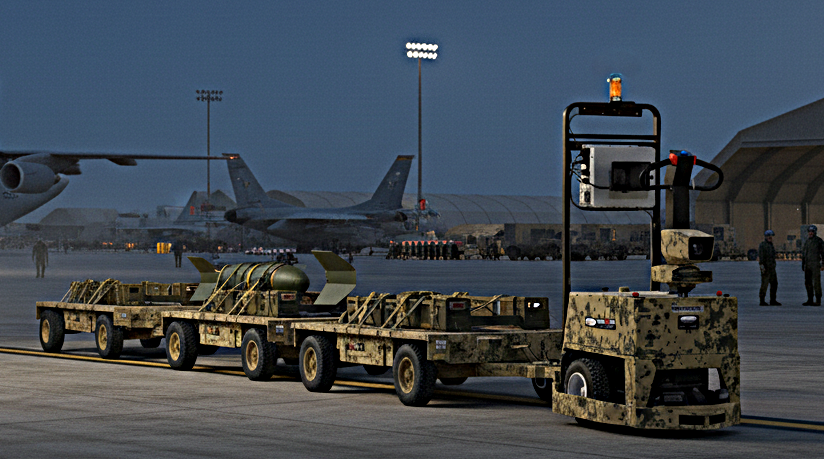
Today, Cyberworks Robotics is rapidly scaling to meet the growing demand for autonomous robots. The company recently announced a major partnership with ASUS IoT to integrate their navigation technology into ASUS hardware, effectively creating a standardized “brain” for industrial robots. Beyond industrial applications, Cyberworks Robotics is moving into the public sector, currently developing autonomous wheelchairs for U.S. airports and a pilot with the Canadian Armed Forces for the safe transport of munitions.
By licensing their stack to a diverse roster of OEMs, Cyberworks Robotics is positioning itself as the foundational layer for the entire robotics industry.
“Anyone can build and sell their own robot. We want to be the Microsoft of robotics,” Burhanpurkar says. “We’re in a similar leadership position that we were in the 80s where we’ve solved a key problem holding back autonomous mobile robotics.”

