Founders Building What Matters: AC:Studio’s Second Cohort Takes the Stage
April 13, 2026
On February 19, 2026, founders, partners, and mentors gathered at the University of Waterloo’s Fed Hall for the AC:Studio Showcase. Sponsored by RSM, Smart & Biggar, and OVHCloud, the showcase was an opportunity for the 23 startups in the second cohort of the AC:Studio program to share what they’re building and connect with potential investors and customers.
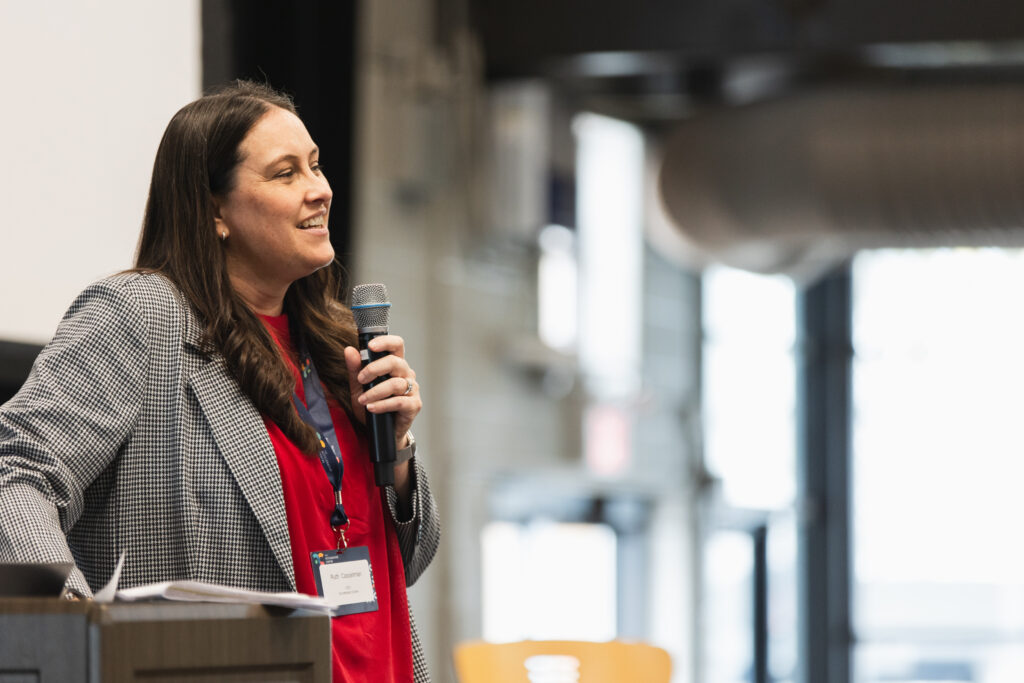
Fed Hall carries a sense of nostalgia for many of those who spent time at UWaterloo. During her opening remarks, Ruth Casselman, CEO of the Accelerator Centre (AC), shared her experiences as a student when the building served as the university’s student bar and club—a place where bands played and students “cut a rug” on what is now a carpeted floor.
The transformation of the space mirrors the evolution of the students themselves. As Joanna Ma of Smart & Biggar noted, 20 years ago entrepreneurship was a concept associated only with Silicon Valley. But today, first-year students arrive on campus with polished elevator pitches and business plans ready to take on the world.
How it all began
In 2022, the AC launched a first-of-its-kind, hybrid venture studio program to provide startups with hands-on support, mentorship, funding, and tactical expertise. With a $10 -million Government of Canada investment, through the Federal Economic Development Agency for Southern Ontario (FedDev Ontario), the first cohort of AC:Studio supported 100 high-potential companies and provided them with up to $100,000 in funding.
The impact of this program was undeniable; the first cohort of AC:Studio saw the creation of 573 jobs, 276 new products, 153 new pieces of intellectual property, over $41 million in investment, and a collective revenue generation of $39 million.
After the success of AC:Studio’s first iteration, the Accelerator Centre set out to build on that momentum with a renewed mission: supporting early-stage startups developing sustainable technologies aligned with the United Nations Sustainable Development Goals (SDGs). Supported by a $3.9-million investment from the Government of Canada, through the Federal Economic Development Agency for Southern Ontario (FedDev Ontario), the second AC:Studio cohort focuses on helping founders develop solutions that address global challenges while fueling economic growth across southern Ontario.
The companies selected for the UN Sustainable Development Cohort of AC:Studio represent a broad range of impact areas and emerging innovation trends:
Cleantech and renewables
Health and patient care innovation
AI and robotics for accessibility and inclusion
Circular economy and sustainable infrastructure Smart cities, mobility, and climate resilience
Since the start of the second cohort in July 2025, the 23 startups supported through this initiative are on track to create 55 new jobs, raise over $11 million in investments, and generate $26.7 million in revenue –demonstrating the impact of investments in early-stage innovation.
“These are tangible contributions to the Canadian economy and proof that investing in early-stage founders pays off, both economically and also through social impact,” Casselman said.
Solving problems that matter
“Every single one of the founders and companies that are here today have been selected because they are actually trying to make the world better,” Casselman said.
This mission-driven approach was the focus of a panel discussion moderated by AC:Studio Program Manager, Adam Dougall, featuring founders who are tackling diverse global challenges aligned with the UN Sustainable Development Goals (SDGs).
The panelists shared the personal stories and market gaps that led to their innovations:
Safety for Firefighters: 94% of line-of-duty deaths for Canadian firefighters are due to cancer. Kade Truman of ArcticEdge Technologies is developing a non-toxic moisture barrier for firefighting gear to eliminate the use of Per- and Polyfluoroalkyl substances (PFAS), carcinogenic forever chemicals used in firefighting gear.
Empowering Patients with Tremors: Emile Maamary is the co-founder of Steadiwear, a battery-free, mechanical glove designed to stabilize hand tremors for individuals with Parkinson’s Disease.
Improving Healthcare Workflows: Christy Lee of PatientCompanion has developed a communication tool that allows patients to specify their needs, helping nurses prioritize tasks and reducing the burnout associated with traditional “red button” call systems.
Manufacturing Efficiency: Dennis Kuzmenko of Innovate-Ops has created an industrial monitoring system for predictive maintenance, aiming to reduce the massive revenue losses companies face due to equipment downtime.
Despite the different industries and problems they’re solving for, the founders agreed on a common theme: technology is only one part of the equation.
“In engineering, we like to think that technology can solve problems. But I think the statement should be that technology can solve problems sometimes,” said Christy Lee of PatientCompanion.
Lee learned about the problems nurses and long-term care workers faced while volunteering at a hospital. She added that understanding not just the problem, but the way people manage the workflows and processes is key to designing the right solution.
“When we are implementing a new tool, we need to understand their current culture and process and workflows to make sure we’re not adding additional workload,” Lee said.
The human connection played a critical role in bringing Kade Truman to the founding team of Arctic Edge Technologies. His co-founder, Drew Davidson, is a material scientist whose mother is a firefighter. After coming home from a funeral for a colleague, she asked her son if he could do anything to help.
Truman, then a business student in the UWaterloo MBET program, heard Davidson pitch the solution at a campus Velocity event and saw the perfect opportunity to bridge the gap between good science and good business.
For Emile Maamary of Stediware, the motivation was also deeply personal. Both he and his CEO watched their grandmothers struggle with hand tremors caused by Parkinson’s. Maamary recalled a Sunday afternoon when his grandmother’s tremors caused her to spill hot coffee, resulting in a burn.
“When we started looking into the problem, we realized that medication and surgery are very expensive, so we decided to tackle this ourselves,” Maamary said.
The solution his team developed is a battery-free, mechanical glove that uses vibration-damping technology—a concept actually inspired by earthquake-resistant building design.
“We believe there’s a massive opportunity for wearables like our device that can accommodate an alternative that’s affordable, with no side effects and high efficacy,” Maamary said.
Dennis Kuzmenko, co-founder and CEO of Innovate-Ops, drew from his experience in the manufacturing industry. He spent two decades searching for a scalable, cost-effective way to monitor equipment and make data-driven decisions before finally deciding to build it himself.
His startup develops industrial equipment monitoring systems for predictive maintenance, helping factories avoid the massive revenue losses caused by unexpected downtime.
Kuzmenko said that in the current era of rapid AI advancement, small, agile startups are better positioned to disrupt the market than traditional corporations.
“Now it’s the best time to build your own business using all those tools, much more efficient than engineers could be ten years ago,” Kuzmenko noted.
Making sustainability work
The panel was followed by a keynote from Aaron Guan, founder and CEO of Neptune Nanotechnologies and an alumnus of the inaugural AC:Studio cohort. Guan offered a candid look at the “muddy journey” of entrepreneurship, sharing how he navigated the collapse of a previous venture and the near failure of Neptune Nanotechnologies.
Guan’s primary advice to the current cohort was to hire people who could be “wartime partners.”
In hardware, things will go south. The tech will fail in the lab. The shipping will get delayed, and investors will get scared,” Guan said. “If you’re a founder in this room looking at the people sitting next to you, your co-founders, your first employees—ask yourself, if you’re only four days away from the end, would I trust this person to stay in the trenches with you? And if the answer isn’t 100% resilient, yes, it doesn’t work.”
One of the more surprising insights was the need to pivot based on market pain rather than mission alone. While Neptune’s nanomaterials were originally intended for advanced industries like aerospace and automotive, the company found its first major commercial success in an unexpected place—the living room.
“We accidentally discovered that one of our primary products is one of the most effective non-toxic fire retardants out there,” Guan said. “And do you know where our first major commercial breakthrough came from? Christmas trees.”
By solving a specific problem for that industry, Neptune proved that a product must be better and cheaper to gain traction, at which point sustainability becomes the reason the customer stays. Guan encouraged founders to embrace these pivots, noting that every challenge—from ghosted emails to shifting markets—ultimately makes the founder stronger.
As the showcase drew to a close and the floor opened for networking, the energy in Fed Hall was a reminder that while the ‘dance floor’ has changed, the spirit of bold movement in Waterloo continues to shine.
Rita Wang has already crossed several continents in her entrepreneurial journey. Her latest stop is Canada, where the founder of Mutopia is preparing to launch a marketplace that connects pet…
The new program, which is part of the Scale-Up Platform delivered by Communitech, helps startups bridge the gap between early traction and scalable revenue by focusing on sales process, customer…